



Binary Search
_author: TatoNaranjo
Implementation in C++
int numbers[] = {1,2,3,4,5,6,7,8,9,10};
int n = numbers.size()-1;
int k; // The variable we want to search in the array
int left = -1; int right = n;
while(right-left>1){
	int mid = (left+right)/2;
		if(numbers[mid]>k)r = mid;
		else l = mid;
}
Implementation in Python
numbers = [1, 2, 3, 4, 5, 6, 7, 8, 9, 10]
n = len(numbers) - 1
k = 5  # The variable we want to search

left = 0
right = n

while left <= right:
    mid = (left + right) // 2

    if numbers[mid] == k:
        print(mid)
        break
    elif numbers[mid] < k:
        left = mid + 1
    else:
        right = mid - 1
Algorithmic Complexity: O(log N)
When can we use Binary Search?
- The problem asks for a minimum or maximum value of something.
- The problem can be solved similarly across all possibilities until a certain point.
Imagine you have a set of elements and you are looking for a condition to be met. This condition has a range where it is met, and another range where it is not.
Binary Property Generalization
One of the pros of binary search is that it is a tool not only used to satisfy a search but also to solve a problem like this:
Given a search space in a range determined by $l$ and $r$, where $l$ is the lower limit and $r$ is the upper limit, and a boolean expression $f(x)$ that satisfies a property; if $f(y)$ is not met, then $f(y-1)$ will not either. We want to find the minimum value of $z$ such that the expression $f(z)$ is met.
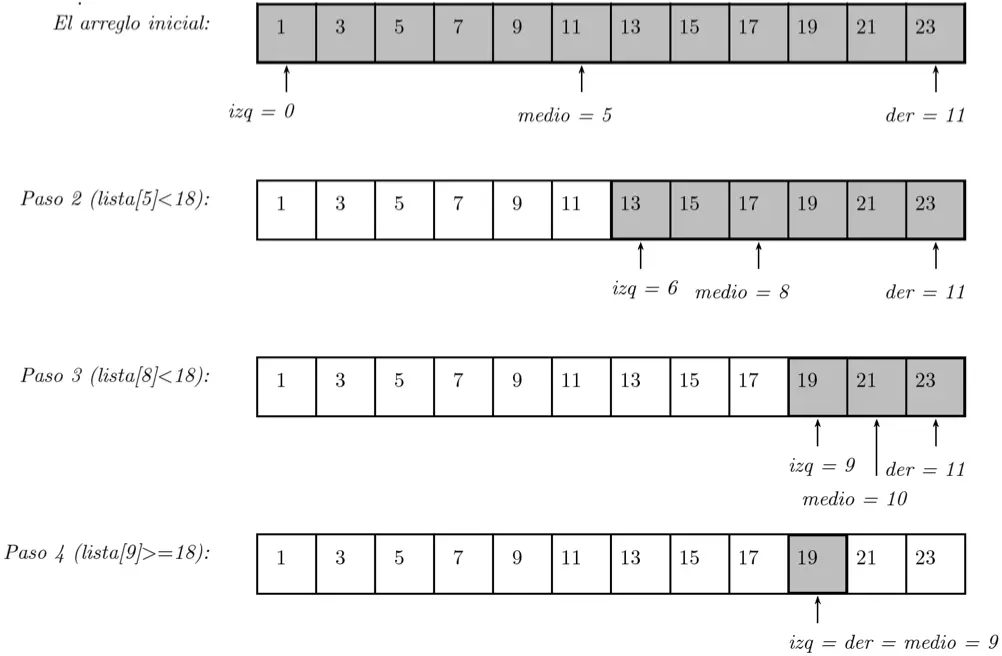
The general idea of the binary property is that if a condition is met for an element $x$, it will also be met for all elements ahead of it because they are sorted in ascending order. The generalization can be represented with the following graph:

An everyday example:
Imagine you are in a game of guessing the number I am thinking of within a specific range. If the number you guess is higher, I’ll tell you to try a smaller number. If it is lower, I’ll tell you to try a higher number.
Therefore, the logic of the game translated to an algorithm follows these steps:
- Let
min = 1andmax = nwhere n is the limit of our range. - Guess the average of
maxandminrounded down. - If you guessed the number, stop searching, you found it.
- If the guess was too low, make
minlarger than your guess. - If the guess was too high, make
maxsmaller than your guess. - Return to step 2.
How to implement the algorithm?
To understand how the algorithm works, we can use the following example:
Imagine we have the following array containing the first 25 prime numbers in order:
int primes[] = {2, 3, 5, 7, 11, 13, 17, 19, 23, 29, 31, 37, 41, 43, 47, 53, 59, 61, 67, 71, 73, 79, 83, 89, 97};And we want to know if the number 67 is prime. If 67 is in the array, we will know it is a prime number.
Knowing this fact, we can also find out how many prime numbers exist below 67.
When we read the array from left to right one at a time to look for the number 67, we are doing a Linear Search that has a complexity of O(N) since in the worst case we would have to search through n elements.

Doing the search, we will realize that the element we are looking for is at index 18, so we would have taken 19 steps. However, we can optimize this.
Since the primes array has 25 numbers, the indices go from 0 to 24. Using the pseudocode, we know min = 0 and max = 24.
The first try of the binary search would be at index 12, which is (0+24)/2.
Is primes[12] = 67? No, primes[12] = 41.

Is the index we are looking for greater or smaller than 12? Since it’s sorted, and 41 < 67, the value 67 must be to the right of index 12. Therefore, we update min to 12 + 1 or 13.
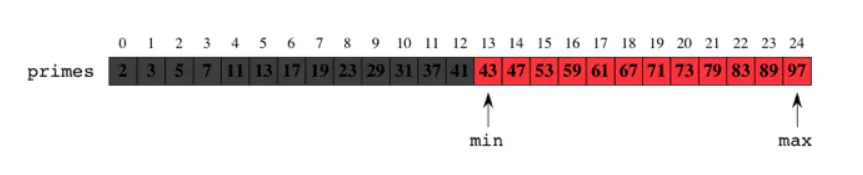
Repeating the previous steps, we find the average of 13 and 24 is 18.5, rounded down to 18. We will find that primes[18] is 67.

At this point, our algorithm stops. We reduced those 19 steps to just 2 steps using Binary Search.
Understanding Algorithmic Complexity:
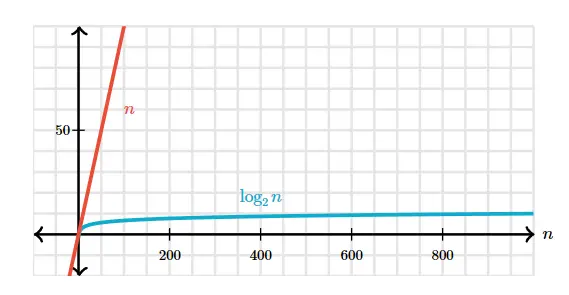
A Linear Search of an array of $n$ elements can take up to $n$ attempts, so binary search takes fewer attempts.
The core idea is that if the search makes an incorrect guess, the portion of the array is halved.
Interpreting this division mathematically, the binary search process becomes $log_2(n)$.
Here is a comparison of $n$ with $log_2(n)$
Exercises for Practice:
- Codeforces - ITMO Courses
- Codeforces - Interesting Drink
- Codeforces - Frodo and pillows
- LeetCode - Find First and Last Position of Element in Sorted Array
Conclusion:

References:
- Explained by SpecterByte.
- Khan Academy: Binary Search